By Brian Dolinar
This article was originally published by Truthout
Organizers discuss how they are fighting new women’s prisons in Vermont, Massachusetts, and Illinois.
As abolitionists across the United States push for decarceration, a backlash has emerged in the form of new prison construction, demonstrating the resiliency of mass incarceration. Several new women’s prisons are being built despite a growing chorus of voices arguing that prisons only inflict more harm on women who have already endured abuse and trauma.
Last year, a new prison to hold nearly 1,000 women was opened in Louisiana to replace the prison that flooded almost a decade earlier. What the news media described as a “campus” (a word used to conflate imprisonment with voluntary settings like colleges and corporate parks) includes a rehabilitation center, classrooms, and a delivery room for women forced to have their babies in prison. In Maine, a new “reentry center” for women was completed in 2017. “Ideally we’d like to say that we don’t need prisons,” then-Gov. Paul LePage said at the grand opening. “But if we’re going to have prisons, this is the type of prison that we need…”
Truthout spoke with activists fighting the construction of new women’s prisons in Vermont, Massachusetts, and Illinois, who said they recognized similar trends. In Vermont, a proposal by the legislature for a new prison for women in Essex was halted last year when activists convinced the local planning commission to rule against a zoning request. In Massachusetts, after calls for a prison moratorium failed, Gov. Maura Healey announced in 2025 a plan to “re-imagine” the women’s prison there. In Illinois, Gov. JB Pritzker and the Illinois Department of Corrections launched in 2024 what is dubbed “RISE IDOC” to build two new prisons, including a new women’s prison with a “gender-responsive” design.
Supporters of prison construction are billing these new facilities for women as “trauma-informed,” “gender-responsive,” and “rehabilitative.” They illustrate attempts to repackage mass incarceration as what author and activist James Kilgore coined “carceral humanism,” or what Angela Davis has described as “carceral feminism.”
“All of this stuff about trauma-informed prisons is a lie,” said Monica Cosby, who spent 20 years incarcerated in Illinois and is now working with the group No New Prisons Illinois to stop the building of a new women’s prison in her state. “It’s both absurd and obscene.”
Playbook Language
In Vermont, the political momentum for reform at the Chittenden Regional Correctional Facility for women in South Burlington was redirected to a plan for new prison construction. A white paper released in 2012 detailed the “disturbing conditions” there that prompted the state legislature to intervene. Instead of sentencing reform or much-needed mental and medical services, legislators chose to build a new prison.
“Our knee-jerk reaction is still prison construction,” said Jayna Ahsaf, founder of Project Abolition and former campaign director of FreeHer Vermont.
The plan for a new prison to hold about 100 women initially costing between $50 and $60 million was eventually approved by the legislature in 2021. In response, a small group of abolitionists launched the campaign FreeHer Vermont, backed by the National Council for Incarcerated and Formerly Incarcerated Women and Girls, in October 2022.
In 2024, the city of Essex was picked as the site for the new prison. Before long, the price tag for the prison, which would be located about 20 miles from the Chittenden prison, had risen to $97 million. FreeHer waged what Ahsaf called a “hyper-local” campaign to convince the planning commission in Essex that the chosen site was not zoned for a prison. Organizers canvassed in the downtown area, handed out zines, held phone banks, and spoke before the planning commission. Every step of the way, she said, they involved incarcerated and formerly incarcerated women.
On March 20, 2025, FreeHer held a press conference at the state capitol building in Montpelier where organizers and service providers spoke along with formerly incarcerated women, including Tiffany Harrington, who gave firsthand testimony.
“The excuse that it’s a trauma-informed prison or a compassionate facility [is] a pile of crap,” said Harrington. “Anytime you take somebody out of their environment and put them in an extremely restrictive environment, you are creating trauma, simply by that action.”
Organizers in Vermont also hosted a webinar with members of the No New Prisons campaign in Illinois. “It was great making connections with the Illinois campaign,” Ahsaf told Truthout, “because we got to see the department of corrections playbook; it was eerie how similar the language they were using in Illinois and Vermont was.”
The planning commission in Essex voted unanimously in October 2025 to reject the state’s zoning request.
“This victory belongs to the people,” said Andrea James, founder and executive director of the National Council for Incarcerated and Formerly Incarcerated Women and Girls.
“Re-Imagining” Prison
Massachusetts Gov. Maura Healey released a plan in 2025 “to support the Massachusetts Department of Correction (DOC) with the re-imagining of the state’s only women’s correctional facility into a rehabilitative environment that advances behavioral health, recovery, and successful reentry.” It called for a hefty $360 million rehaul of Massachusetts Correctional Institution-Framingham, which holds about 200 women.
The design would be a “campus-like setting” representing an “investment in people” and a “commitment to second chances.” It would be a “national model” of prison “innovation” providing “trauma-responsive care.”
In 2022, legislators had passed a five-year moratorium on new jail and prison building, but the bill was vetoed by then-Gov. Charlie Baker.
In an op-ed for a local newspaper, Lois Ahrens, founder of The Real Cost of Prisons Project, a national organization based in Massachusetts, said that by framing the project as a “re-imagining,” Governor Healey “circumvented the language of the moratorium.”
Women who are currently locked up at MCI-Framingham have been at the center of the organizing against the prison. “Incarcerated women have been leading the opposition to prison construction as a response to their needs as well as shaping what we’re fighting for on the outside,” Mallory Hanora told Truthout. She is co-director of Families for Justice as Healing, founded inside prison by Andrea James, who is currently running for governor in Massachusetts.
In 2023, incarcerated women testified over video from inside MCI-Framingham for the first time ever to support the moratorium. In early 2026, Families for Justice as Healing released a report titled, “Hear Our Voices,” featuring interviews with women at the prison. “Building new buildings and keeping the same people won’t fix anything,” said Sandra Dostie, an incarcerated woman, in the report.
“They’re saying that this new building is going to provide better mental health care because women will be sitting in a nicer room,” Hanora explained. “There is no plan to have different providers, more extensive providers, anything like that.”
Claims by activists are being bolstered by the Women and Incarceration Project (WIP), a Boston-based research organization at the Center for Women’s Health & Human Rights at Suffolk University. Norma Wassel, a social worker with WIP, said that while the population at Framingham has been cut by 63 percent since 2017, many of the women still there are overclassified — 80 percent should labeled minimum security.
“Why are you maintaining or building a new women’s complex of medium security?” Wassel questioned. “Did they evaluate other buildings that were empty? Did they evaluate how many people could be on medical parole? There are other alternatives such as clemency.”
In 2018, a prison reform bill was passed in Massachusetts that included medical parole, but the number of people that have been approved for release because they are terminally ill or medically incapacitated has been low. A bill strengthening medical parole and establishing parole for the elderly has been introduced but failed.
No New Prisons
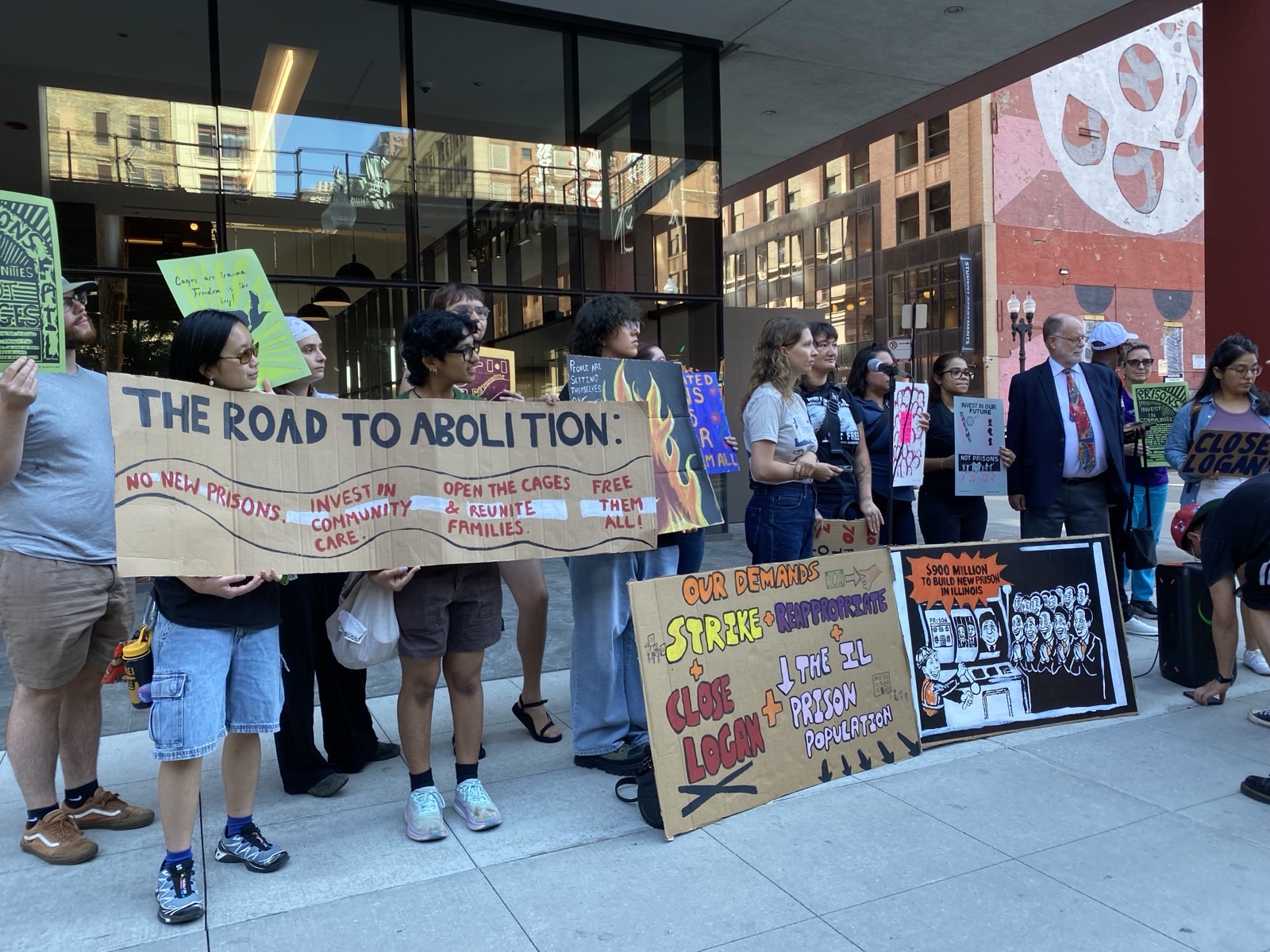
The largest women’s prison in Illinois, Logan Correctional Center, holds about 1,000 people. In 2021, three incarcerated women who were made to clean up raw sewage held a hunger strike, drawing attention to the worsening conditions at the prison. A report released two years later found the facility to be “unsuitable for any population.” In 2024, Governor Pritzker unveiled a plan to close Logan women’s prison, as well as Stateville men’s prison, at a total cost of $900 million.
“People want out,” said Cosby. “There are people who absolutely want Logan shut down and to be moved.” She cited caving ceilings, no heat in the winter, and contaminated water. But first prison authorities should use “all available mechanisms to decarcerate,” she said, such as releasing those who are sick and elderly, or who are eligible for clemency. “It’s not necessarily that people want a new prison, they just don’t want to be in a life-endangering prison.”
On June 5, 2026, the Illinois Department of Corrections announced that the new women’s prison will be built in Crest Hill, Illinois. Prisoners faced retaliation from those about to lose their jobs: The following month, a tactical unit of correctional guards known as the “Orange Crush” began performing sweeps of the prison, reportedly looking for a lost dental tool.
According to the testimony of women inside, who requested their names bewithheld out of fear of retaliation, it was a terrifying show of force. One woman said members of the tactical team were calling them “bitches” and “hoes.” Guards confiscated their property. Those who did not comply were put in solitary confinement.
Hearing these stories, advocates on the outside with No New Prisons made phone calls to the warden and sent emails to state offices in Springfield. Soon after, the sweeps stopped.
No New Prisons received a letter reply from the Illinois Department of Corrections stating that supervisors were overseeing the operations of the tactical team and searches were “handled with gender responsive appropriate behavior.”
Another woman said she would welcome a new facility if it would “motivate, educate, and renew” people — but a prison cannot do those things. “You could never dress up a garbage can.”
This article was originally published by Truthout and is licensed under Creative Commons (CC BY-NC-ND 4.0). Please maintain all links and credits in accordance with our republishing guidelines.