Way back in the earliest epochs of the Universe, the Big Bang was followed by a period called the Cosmic Dark Ages. It was a time when the cosmic soup of primordial particles was so thick that light couldn’t propagate. Hence the term “dark”; also, because, even with our best telescopes, we can’t see “into” that epoch. Although we don’t have a definite “century by century” timeline of activity, it doesn’t mean this period of history didn’t lead to something interesting.
Gravity (and the action of dark matter) was acting on material in the infant Universe, pulling clumps of gas together. Some of the earliest stars began forming in those clumps, along with the first proto-galaxy objects. The stars were consuming hydrogen in their cores, turning it into helium. When they began to shine, that marked the beginning of the end of the dark ages, as ultraviolet light from the stars was able to make its way through the cosmic soup. We on Earth “see” that UV light stretched by the expansion of the Universe as infrared light.
As the stars evolved — and those early stars were weird monsters that lived fast and died young — they fabricated heavier elements in their cores. Through the action of stellar winds and supernova explosions, those stars started the chemical enrichment of the cosmos.
That’s the updated story of early Universe evolution that astronomer Yongda Zhu of the University of Arizona Department of Astronomy is uncovering using JWST infrared observations of three ancient galaxies that existed in that early time. “We observed that heavy elements escaped from galaxies very, very early in cosmic time,” said Zhu, first author of a paper about this work. “Not only were the galaxies producing these elements, but they were also dispersing them, possibly seeding other galaxies.”
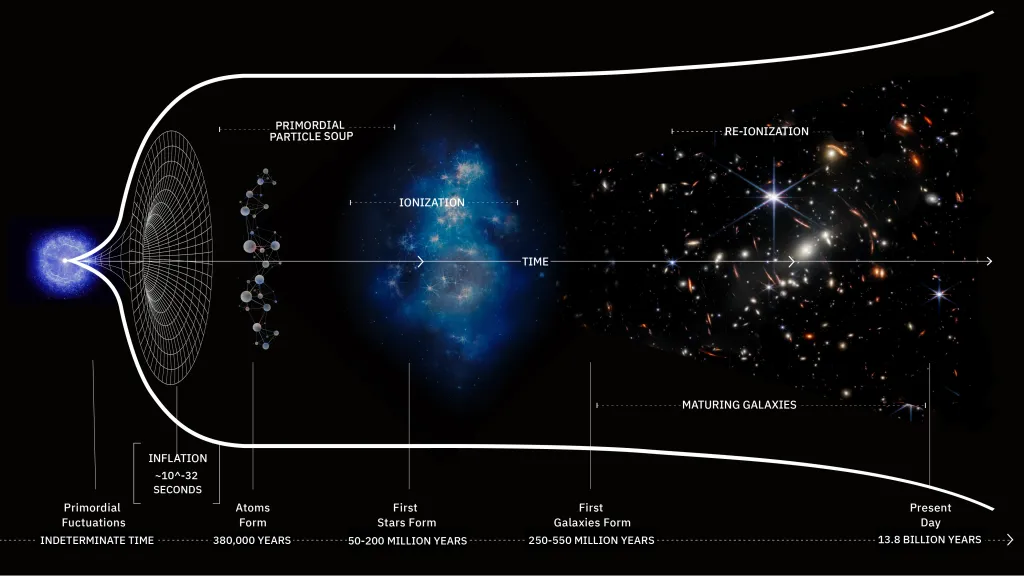
Timeline of the Big Bang, emphasizing the early Universe and Epoch of Reionization. Credit: Big Think/Ben Gibson/NASA/Pablo Carlos Budassi
Three Early Galaxies and the Epoch of Reionization
Zhu’s three galaxies looked (through JWST’s spectral instruments) as they did when the Universe was about 500 million years old. They lie more than 13 billion light-years away from us and lie squarely in the Epoch of Reionization. Along with other early stars, they transformed the Universe by ionizing hydrogen nuclei around them, which allowed light to shine through. In time, the stars began to die, thus moving the elements they produced to the surrounding environments. “We used the galaxies themselves as background light sources,” said Zhu. “As light from the galaxies traveled toward Earth, it passed through surrounding gas, and we were able to look at the light’s absorption patterns to detect specific elements.”
How do astronomers know those elements were there so early on? Zhu went hunting through archives of JWST data to find galaxies with absorption spectra that showed evidence of the “heavy” elements carbon, oxygen, and silicon. (They’re heavier than hydrogen and helium, and are also known as “metals”.) He found three with spectra that showed these and other elements, as well as a distinct blueshift. That shift shows that the enriched gases were moving away from the galaxies and “toward” us. According to Zhu, these galaxies look a lot like evolved galaxies (chemically). That means that even in the earliest epochs of cosmic history, stars and galaxies were enriching the Universe with elements made inside stars. That’s important, since those elements are what other stars and planets (and life) are made of.
“Think of these elements, which originated from the galaxies’ stars, as food dye dropped into a cup of water,” said Zhu. “The color begins to spread through the water, and, similarly, these heavy elements from early galaxies began to escape into space and ‘enrich’ their surroundings.”
Are Chemically Enriched Galaxies the Graveyards of the First Stars?
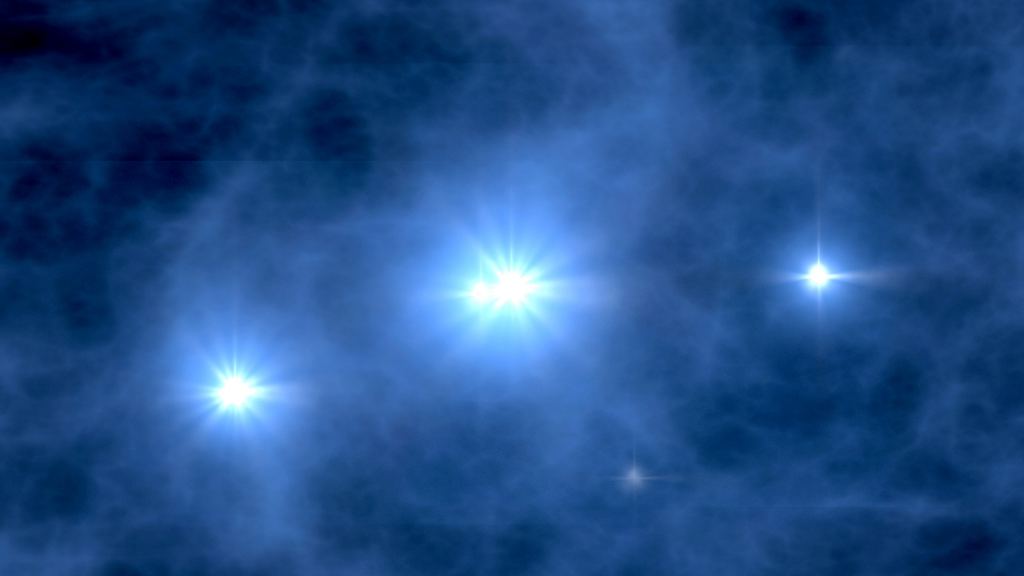
This artist’s illustration shows several Population III stars as they may have appeared, which are all far more massive and far more bright than our Sun. Credit: NASA/WMAP Science Team
Astronomers have been on a constant search for the first stars (called Population III stars) for many years. They’re tough to find for a couple of reasons: they’re distant, and most (if not all) of them have died out. They began a long history of stellar nucleosynthesis (the creation of elements in their cores), which then led to the enrichment of their galaxies, which then led to interconnected exchanges of that material between galaxies (also known as “baryon cycling”).
All of that material gets recycled into new stellar populations, eventually. The Sun, for example, is a Population I star, indicating that its materials have been through at least one (if not several) stars. The existence of baryon cycling so early in the Universe’s history indicates a highly efficient star formation cycle not all that long after the Big Bang. And, thanks to those earliest stars (which may all be gone from our sight), we can see the beginning of the chemical evolution of the stars and galaxies.
For More Information
JWST Finds Early Galaxies Were Already Seeding the Universe With Heavy Elements
Early Metal-enriched Baryon Cycling Before the Midpoint of Cosmic Reionization