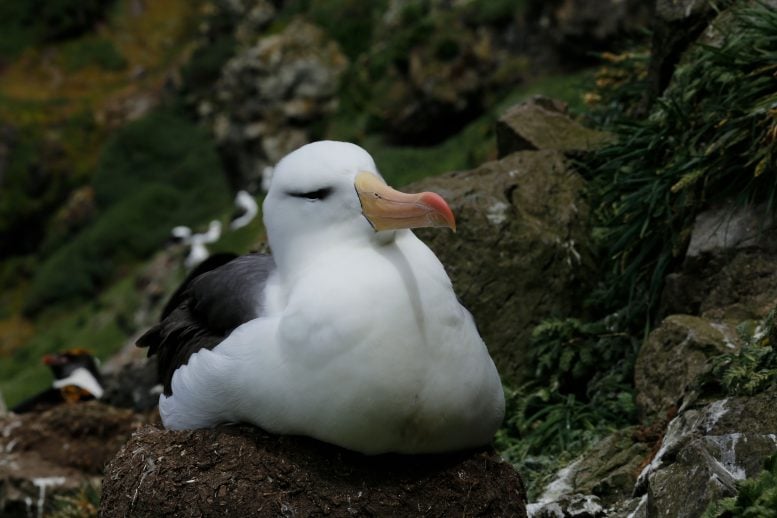
A new study suggests that black-browed albatrosses may not evolve fast enough to keep pace with climate change. Cutting greenhouse gas emissions could give them a better chance of survival.
Black-browed albatrosses, long-lived seabirds of the Southern Ocean and surrounding seas, may need more time to adapt to climate change than a warming world allows. Helpful inherited traits can spread through their populations over generations, but the birds’ numbers can fall before those changes do enough to help.
New research suggests that cutting greenhouse gas emissions would improve their prospects far more than relying on evolution to keep pace. Substantially limiting emissions reduced the projected probability of extinction by approximately half. Evolution helped under some conditions, but generally could not prevent population declines under future warming scenarios.
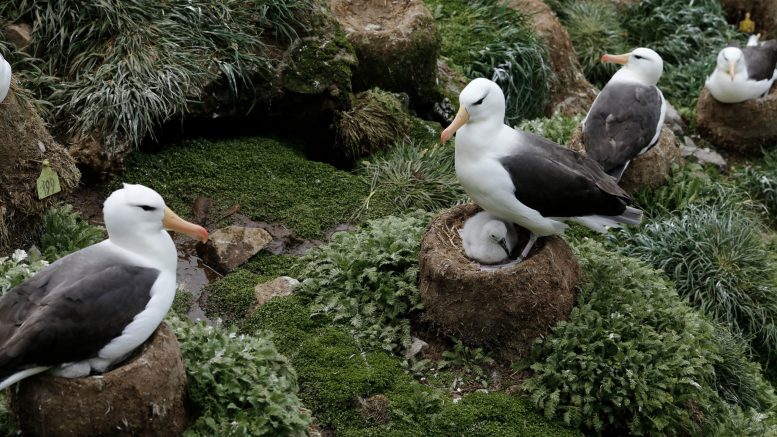
Can albatrosses evolve fast enough?
The research, published in the Proceedings of the National Academy of Sciences (PNAS), draws on more than three decades of records of population changes and individual traits in black-browed albatrosses, which spend most of their lives gliding far out at sea. The authors include Stéphanie Jenouvrier, a senior scientist at the Woods Hole Oceanographic Institution (WHOI).
The team combined those records with information about how traits pass from parents to offspring and projections of future climate. Their computer model tracked how differences in physical characteristics, behavior, and breeding timing affected survival and reproduction. This allowed natural selection and evolutionary change to emerge over time, as traits that improved those outcomes could become more common. The model also accounted for uncertainty in population changes and natural climate fluctuations.
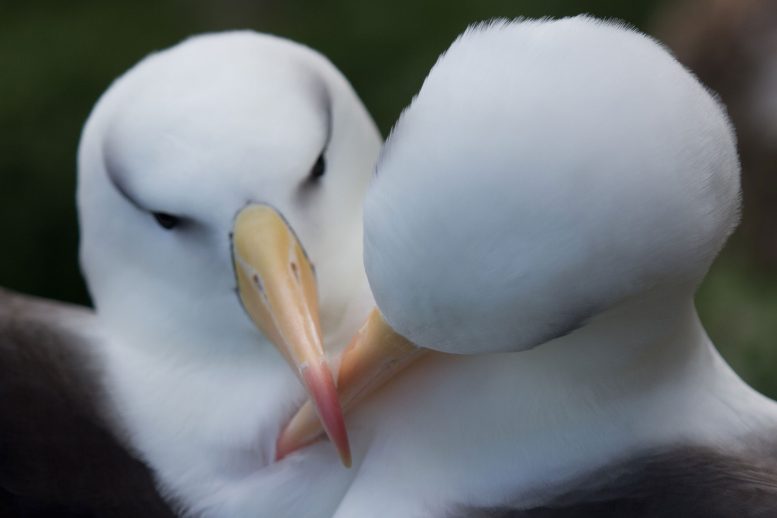
“Some traits, such as wing length, can help young birds survive, but the key question is whether evolutionary changes in those traits can happen fast enough to keep pace with climate change,” said co-author Joanie Van de Walle of the Université du Québec à Rimouski.
Inheritance alone offers little protection
The ability to pass traits to offspring offered little protection against extinction in the simulations. That finding suggests that inheritance alone does not determine whether a population can adapt successfully. The outcome also depends on how strongly natural selection favors useful traits and how environmental changes affect survival and reproduction.
An advantage at one stage of life may also have a different effect on the population’s future than an advantage at another stage.
“Our results show that evolutionary rescue depends not only on how quickly the environment changes, but also on where evolution acts across the life cycle,” said Jenouvrier. “Evolution can help when adaptation improves the parts of the life cycle that matter most for population growth, but limiting the rate and magnitude of climate change gives adaptation a much greater chance to contribute to population persistence.”
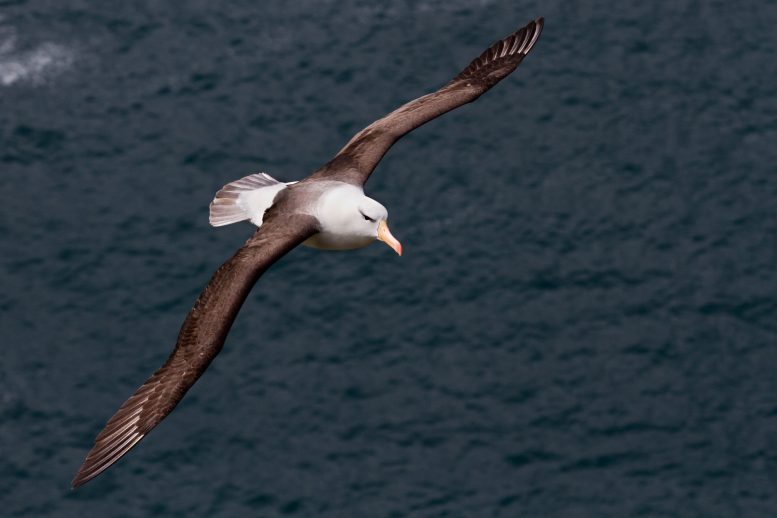
Evolutionary rescue describes a population avoiding extinction through adaptive evolutionary change after its environment deteriorates. Scientists have proposed it as a possible buffer against climate-driven biodiversity loss. Whether it can happen quickly enough remains uncertain, particularly for long-lived species such as albatrosses, whose relatively long generation times can delay evolution’s influence on population trends.
Stronger warming can overwhelm adaptation
The simulations showed how much the surrounding climate matters. Under the relatively stable conditions of the past, populations allowed to adapt through evolution were projected to grow larger than those without that adaptation. Under future climate conditions, evolutionary responses could contribute to the population’s continued survival when warming was sufficiently limited. Stronger warming generally overwhelmed those benefits.
“Evolution can help populations cope with environmental change, but our results show that it has limits,” said Jenouvrier. “For this long-lived seabird, limiting the magnitude of climate change has a much greater effect on population persistence than evolutionary adaptation alone.”
Co-author Marika Holland, a scientist at the National Center for Atmospheric Research, explained how emissions reductions could give adaptation more room to work.
“The rate and magnitude of future climate warming impacts the effectiveness of evolutionary adaptation. Reducing future climate change by decreasing greenhouse gas emissions slows population decline and enables evolutionary adaptation to promote population persistence.”
Reference: “Climate mitigation contributes more to population persistence than evolutionary adaptation in a long-lived seabird” by Stéphanie Jenouvrier, Jimmy Garnier, Marika Holland, Joanie van de Walle, Samantha C. Patrick, Timothée Bonnet, Karine Delord, Francesco Ventura, Christophe Barbraud and Henri Weimerskirch, 21 September 2026, Proceedings of the National Academy of Sciences.
DOI: 10.1073/pnas.2620362123
This study is part of the long-term Studies in Ecology and Evolution-Life program of the CNRS. This work was supported by the National Science Foundation (Organismal Response to Climate Change grant 2222057).
Never miss a breakthrough: Join the SciTechDaily newsletter.
Follow us on Google and Google News.